Home › Blog › During › Places you'll pass
The door built for the pilgrims who couldn't finish
A stone church in Villafranca del Bierzo, a silver hammer, and the oldest answer to "what if I can't." In 2027 it matters more than most years
The Puerta del Perdón, the Door of Pardon, is a side doorway of the church of Santiago in Villafranca del Bierzo, on the Camino Francés about 115 miles (185 km) before Santiago. In a Holy Year, such as 2027, it is opened for pilgrims who are too sick or too hurt to continue, and by tradition they receive the same Jubilee indulgence as those who reach the cathedral. It is not the Compostela certificate; that is still issued only in Santiago. Outside Holy Years the door stays shut.
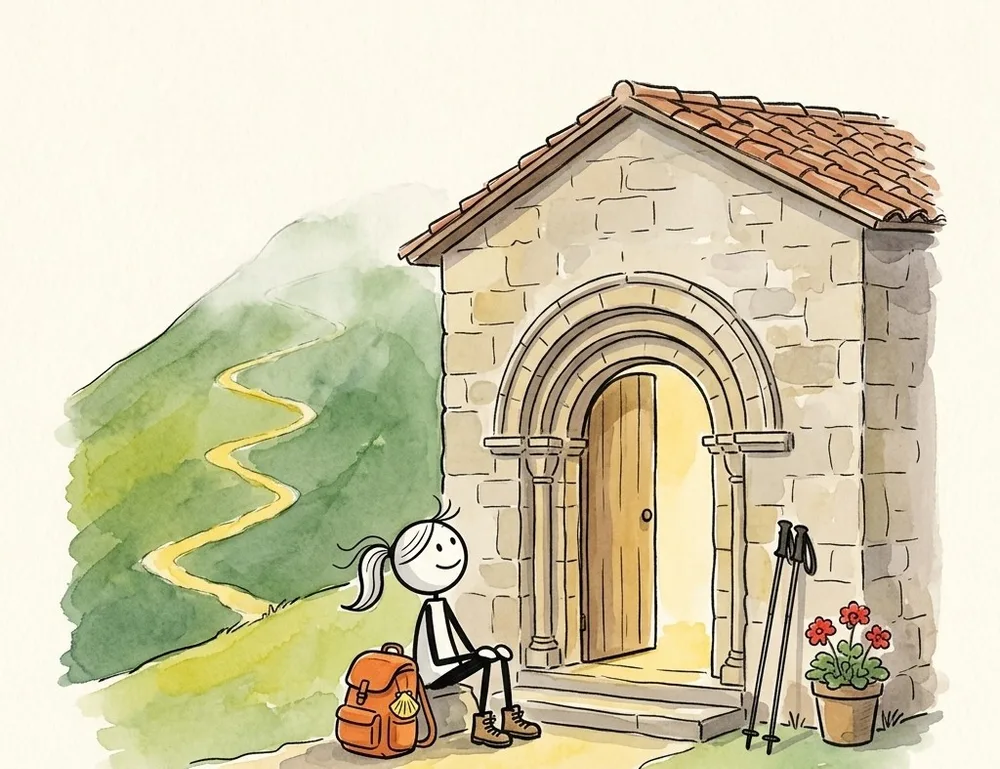
What if I get there, and halfway through, I can't?
If that question has a chair at your kitchen table, this story is for you. It happened, and still happens, in a small town in a green valley in northwest Spain. It sits in the Holy Year section of this blog for a simple reason: the door at the center of it opens only in Holy Years, and the next one is 2027. This isn't a legend. The door is real. You can put your hand on it.
A town at the foot of the last mountain
Villafranca del Bierzo sits where two rivers meet, about 115 miles (185 km) before Santiago on the Camino Francés, the most walked route. It is a pretty place: a castle with round towers, a long street called Calle del Agua lined with old houses, wine from the Bierzo valley on every table.
It is also the last comfortable night before the climb. A day beyond Villafranca the road rises to O Cebreiro, a village of round stone houses on a ridge at about 4,300 feet (1,300 m), the gateway to Galicia, the last region before Santiago. It is the last big climb of the whole route. There are hills after it, but nothing like this.
Now picture arriving here five or six hundred years ago. You have walked for weeks, maybe months, from France or beyond. You are days from the end. And your body has stopped cooperating. A fever. A leg that will not take another step. Simple exhaustion, in a time with no bus, no taxi, no phone call home, and a mountain in the way.
For some pilgrims, Villafranca was where the Camino ended, whether they wanted it to or not.
The door
At the entrance of the town, right on the pilgrim road, stands the church of Santiago. It is Romanesque, the medieval style of thick walls and round arches, and its records go back to 1186, when the bishop of Astorga got permission to build it. That makes it more than 800 years old. Small, plain, solid, the kind of church that looks like it grew out of the hillside.
On its north side there is a doorway under carved stone arches. It is called the Puerta del Perdón, the Door of Pardon.
Most of the time it is shut. But in a Holy Year, it is opened. A Holy Year, or Año Santo, is a special pilgrimage year that comes around whenever July 25, the feast of St. James, falls on a Sunday. During a Holy Year the Church grants pilgrims who reach Santiago the Jubilee indulgence, a full, or plenary, indulgence, which in Catholic teaching lifts the remaining penalty for sins already forgiven, with the usual conditions attached: a visit to the cathedral, confession, communion, prayer. And in those same years, by a tradition the diocese still honors, a pilgrim who could not continue could enter through this door in Villafranca and receive the same indulgence. Not a smaller version. The same thing.
That is why people call the town "la pequeña Compostela," the little Compostela, after Santiago de Compostela, the cathedral city at the end of the road.
A silver hammer on New Year's Eve
The opening is a ceremony. On December 31, the day before a Holy Year begins, the bishop comes from Astorga, the diocese, or church district, this corner of Spain belongs to, and strikes the door three times with a silver hammer. From that moment the privilege is in force for the whole year. The door itself, though, is not left standing open. It is unlocked for each pilgrim who needs it, which tells you how seriously the town takes it.
The privilege is old, and its paperwork is blurry. Tradition credits a pope with granting it in the 1400s, though the sources disagree about which pope and which year, so I won't pretend to know. What is certain is that the door was walled up for a century or more, reopened in 1948, and has opened in Holy Years since.
The numbers are small and that is part of the point. In the Holy Year 2010, 48 people received the Jubilee here, most of them a group of pilgrims with disabilities from León. In 2021, the pandemic year, by the end of December one person had. One. The door was opened anyway, with the hammer and the bishop and the whole ceremony, for whoever might need it.
The next Holy Year is 2027. The door is expected to open on December 31, 2026.
What the door does, and what it doesn't
Let's be precise, because precision is a kindness here.
The Door of Pardon is a religious thing. It grants the Jubilee indulgence, in Holy Years only, to pilgrims who genuinely cannot go on. Expect to be asked for proof: a doctor's note, by most accounts, and evidence that you had already walked a good stretch of the route before you had to stop. It was never meant as a shortcut for the healthy, and it isn't one now.
It does not grant the Compostela, the certificate the Pilgrim's Office in Santiago gives to pilgrims who complete the walk. That certificate still asks for at least 62 miles (100 km) walked without gaps on one route, with your final stage walked into the cathedral. You may hear the thought, especially since the Pilgrim's Office reworded its rules in early 2025 and many walkers read the new text to mean those miles no longer have to be the very last ones, that Villafranca could become an official finishing point. It's a lovely idea, and as of today it isn't how it works. The door and the certificate are two different kinds of "you made it."
And yet.
Who decided this?
I keep coming back to one question. Somewhere, centuries ago, somebody looked at the pilgrims lying in Villafranca with a fever, days from Santiago, and decided that their walk counted. Not as an attempt. As the real thing. Then that somebody persuaded a pope, and a bishop, and a town, and here we are, centuries later, still opening the door.
Most of what you'll read before your first Camino is about finishing. Which route, how many days, where the certificate is handed out. Almost nothing is about the day you can't. This door is the Camino's oldest answer to that day, and it is not "try harder." It is: come in.
That doesn't mean you will need it. Most people don't. It means the fear you carry has been carried before, by people with far fewer options than you, and the road made room for them.
The practical part
Today, "I can't go on" in Villafranca looks different, and gentler. A few things worth knowing before you ever need them:
- A rest day is a tool, not a failure. Villafranca has beds, a pharmacy, cafés and the kind of afternoon light that makes stopping feel wise. Many walkers who think they're done find that one day off changes the answer.
- The mountain has a road. From Villafranca, a daily bus and local taxis run up the valley toward O Cebreiro (the bus stops at Pedrafita, about 2.5 miles / 4 km short of the village), and luggage services carry your pack to the next stage, so a bad knee doesn't have to carry the weight too.
- You may stop and come back. The Pilgrim's Office allows the walk to be done in stages over separate trips, as long as they follow in order and you collect dated stamps where you stop and where you start again. Villafranca is a natural place to stop, and a natural place to return to.
- Know your out. Before you leave home, look up how to reach Santiago or an airport from the middle of your route. Knowing the exit is usually what lets you stop thinking about it.
- If you walk a Holy Year, step inside. In 2027, if your route takes you through Villafranca, the privilege will be in force, even if the door itself is kept shut between the pilgrims who need it. You don't have to be sick to stand in front of it and think about who it was built for.
The step
Finish this sentence, honestly, and write it down: The "what if I can't" that keeps me up at night is...
Now notice that the Camino wrote its answer in stone, with conditions and only in Holy Years, but it wrote it. Yours can be smaller: a rest day, a bus timetable, a plan to come back. The point is the same. The ones who can't, count too.
 The fears every first-timer carries, and the plans that quietly take their power away, are what the book is about. the book →
The Shelf: gear for the CaminoWhat buyers love, and what to know first. open the Shelf →