Home › Blog › During › Hard days & weather
What if I want to quit the Camino on day three?
A note for the bench, before you look up the bus to the airport
It's common to hit a low in the first few days, while your body is still adapting. Muscle soreness is strongest one to three days after new effort, so it tends to peak right about then. Don't decide in the worst hour. Eat, sleep, walk one short day, then decide. Sharp or worsening pain is a question for a doctor or pharmacist.
You're planning your first Camino, and there's a thought you haven't said out loud.
What if I get there and I hate it? What if it's day three, everything hurts, and I want to go home? I told everybody I was doing this.
Let's go there now, on purpose, so it can't surprise you later.
The bench
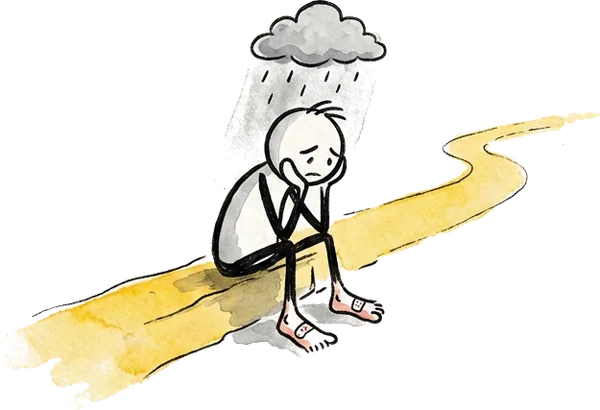
It's the third morning, somewhere around eleven. There's a bench outside a bar, and you are on it with your boots off and your socks steaming gently in the sun. You had planned to be four miles farther by now. Above you, one small private cloud.
Your calves are not speaking to you. The pack has made friends with gravity overnight. Other pilgrims walk past, and every single one of them looks fine. It's just me, you think. I'm the only one who can't do this.
Your thumb is already typing: bus to airport
Stay on the bench a minute. I want to show you what's going on.
Three things the bench won't tell you
I trained for months. Why does it still hurt this much? Because your muscles run on a delay. After effort your body isn't used to, soreness doesn't peak the same day. Sports medicine puts the peak at one to three days later. You started walking on day one and haven't stopped since. So day one's soreness tends to be loudest somewhere between the second morning and the fourth, with day two's already stacking on top. The third morning sits in the middle of that. It tells you what your legs did this week. It doesn't tell you who you are.
Everyone else found their stride. Maybe you're just in the gap. One Camino travel company puts it this way: the first two or three days are the hardest, while the body adapts, and by about day four most walkers have found their rhythm. It's one company's view, not a statistic. But if it holds for you, day three sits right before the turn. It's a lonely little gap.
It's just me. Pain makes your world small. A Camino coach who has walked four Caminos retells a story he read online. A man prepared for everything. On day three he walked to a bus stop, rode to the airport and flew home. His feet and one knee were in real trouble, and that part was real. But the coach points to something else: people seldom go home over gear. Pain shrinks your world to the next few yards. You stop looking up. By the third night the man had not had one real conversation, and he had decided everyone else belonged there except him. That's the trick of the bench. Some of those people look fine only because you've stopped asking them.
What other pilgrims keep in their back pocket
Imagine the bench could answer. It might say what pilgrims told a first-timer on a Camino forum in August 2026, who asked what to do if a day turned out to be too much. About twenty people answered. No single answer won, but a few ideas came up more than once.
- Make the day shorter. Several said it: two easy days are kinder than two days of gritting your teeth.
- Cut the day into small walks. A couple of people think in pieces: a long day is just a few short walks with real rests in between, a long lunch, feet up.
- Know your exit. What do I even say in Spanish? Less than you think. Walk into a bar, order something, and ask them to call a taxi to your next bed. One pilgrim added that a backup plan in your pocket can make the real plan easier to keep.
- Send the pack ahead. On the main routes, in season, transfer services carry your backpack to the next place you've booked. The Spanish post office wants the booking by 8 p.m. the evening before, so this one rescues tomorrow, not this morning.
One thing to know: the Compostela asks for at least 62 miles (100 km) on foot, in one unbroken line on one route, ending in Santiago. If you take a taxi inside the miles you're counting, pilgrims suggest riding back the next morning to the spot where you stopped and walking on from there.
The bench rule
Here's the only rule I'd ask you to pack: never decide on the bench.
The bench is the worst hour of the worst morning. It gets no vote. Three things first: food, a bed, one short day. Get to that bed on foot or by taxi, no medals either way. Then you vote.
But I told everybody. You did. And not one of them is on this bench. The people who love you want you back safe, not a certificate.
If the answer is still "I want to go home," that's a real answer. You asked it rested and fed, not hurting.
You can use the rule before you ever fly, by the way. When the 2 a.m. doubts arrive at home, that's a bench too.
The honest part
Sometimes stopping is right. Pain that is sharp, that gets worse as you walk, or that simply worries you is not a mood. It's a question for a doctor or a pharmacist, not for willpower. Going home is not failing. The road has been there for more than a thousand years. It will wait for you.
And I can't promise you that day four will feel better. Some pilgrims say it does. Yours is yours.
Before you go
So pack these next to the socks: the exit you know about. Permission for a short day. And the bench rule.
As for the thought you hadn't said out loud? You just did. Now it travels in the open, where you can keep an eye on it.
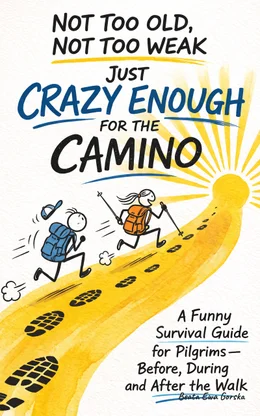 Why your head lies to you around day three, and how to plan that day before you leave home: that's Chapter 17 of the book. the book →
The Shelf: gear for the CaminoWhat buyers love, and what to know first. open the Shelf →
Why your head lies to you around day three, and how to plan that day before you leave home: that's Chapter 17 of the book. the book →
The Shelf: gear for the CaminoWhat buyers love, and what to know first. open the Shelf →