Home › Blog › Before › Which way, and when?
Which Camino should you walk first? The honest answer, and the one nobody says out loud
Five roads, one question, and a very opinionated voice in your head
The Camino Francés is the most walked route, about 43 in 100 pilgrims this year, and about 7 in 10 of those start in Sarria, roughly 70 miles (115 km) from Santiago. If you want company and a well-marked road, choose the Francés. If you want the sea, flatter days and a quieter walk, choose the Portuguese Coastal route. If you have one week, the Camino Inglés fits. The Compostela certificate requires at least 62 miles (100 km) on foot without gaps on one route, with your final stage walked into the cathedral, whichever road you pick.
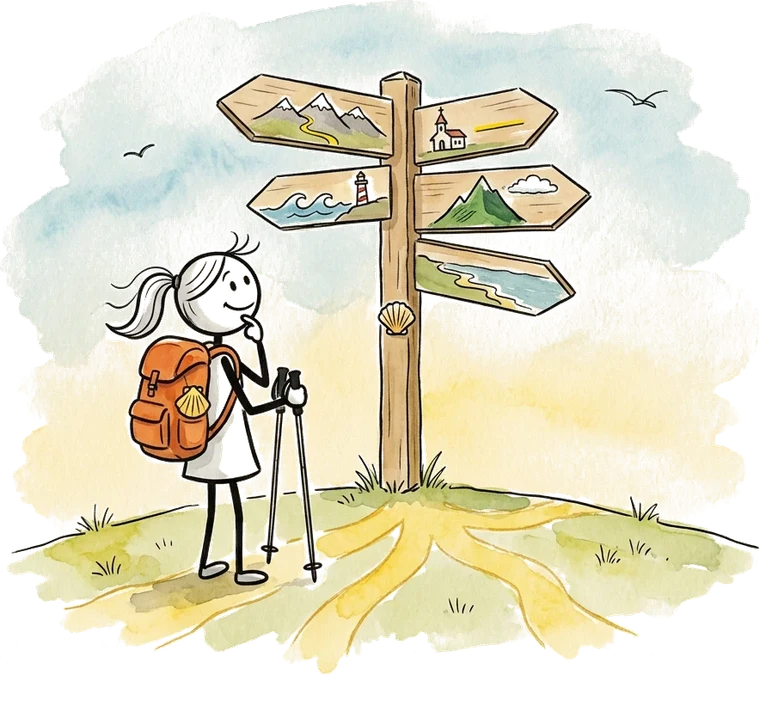
There is a moment, somewhere between "I think I want to do this" and "I've booked it," when the Camino de Santiago stops being one road and turns into five.
You open a map. Francés. Portugués, which comes in two flavors. Inglés. Primitivo. Norte. Somebody in a forum swears by one. Somebody else says that one is "ruined." A third person says the only real Camino is the one you haven't heard of. You close the map.
The voice in your head, which has opinions about everything, says: "See? You can't even pick a road. How are you going to walk one?"
Let's quiet the voice with something it doesn't have. Numbers, and then an honest look at each road.
What the numbers say
The Pilgrim's Office in Santiago counts everyone who walks in and asks for the Compostela, the certificate you receive for walking at least 62 miles (100 km) on one route and finishing on foot at the cathedral. There are more than five Caminos, but these five account for most of the walking. The office's figures for 2026, as of late September:
- Camino Francés (the French Way): about 43 in every 100 pilgrims.
- Camino Portugués (the Portuguese Way), the inland route: 20 in 100.
- Camino Portugués along the coast: 19 in 100.
- Camino Inglés (the English Way): nearly 6 in 100.
- Camino Primitivo (the Original Way): under 5 in 100.
- Camino del Norte (the Northern Way): under 4 in 100.
Two more numbers matter. Nearly 30 in 100 pilgrims started in one town: Sarria, about 70 miles (115 km) from Santiago on the Francés, just beyond the minimum for the certificate. And the largest group of foreign pilgrims this year came from the United States, ahead of Italy and Germany. If you're an American woman planning your first Camino, you are in very good company.
The office doesn't count first-timers separately, but the plain answer to "which Camino do most people choose?" is the Francés, and most often its last stretch. The better question is whether that's right for you.
The Francés: the road with the safety net
About 485 miles (780 km) from Saint-Jean-Pied-de-Port, in France, to Santiago. Thirty to thirty-five walking days if you do all of it, which most people don't.
What it's really like: yellow arrows on nearly every corner, a bed in the next village more often than not, a café that opens before you do, and nearly always someone ahead of you who took the same wrong turn ten minutes ago. It is the busiest road, which is exactly why many first-timers find it the easiest to walk alone. You start alone. You probably won't stay alone.
The honest part: from Sarria onward in summer, it is crowded. Beds may go early, and some villages feel like a slow parade. If silence is the thing you came for, the last week of the Francés in high season may not give it to you.
You can start in Saint-Jean, in León, in Sarria. Nobody asks where you began, only that your miles are stamped and that you walk into the cathedral on your own feet.
The Portugués: two roads, one coast
From Porto, the inland Central route is about 155 miles (250 km) and takes most people around 12 days. The Coastal route is roughly 175 miles (280 km) and runs beside the Atlantic for days before turning inland. Many people start at Tui on the Spanish border instead, about 73 miles (117 km) from Santiago, which is why Tui is among the most common starting points on any Camino, after Sarria and Porto.
What it's really like: flatter than the Francés, especially along the coast. Boardwalks over dunes, fishing towns, the smell of the sea at breakfast. Quieter than the Francés, though no longer quiet: the coastal route grew by about a fifth in 2025, and this year the two Portuguese routes together carry almost four in ten pilgrims.
The honest part: more pavement than some walkers like, and on parts of the Central route the yellow arrows share the wall with blue ones pointing the other way, toward Fátima, the Catholic shrine in central Portugal. You learn to read them.
The Inglés: a whole Camino in one week
About 73 miles (118 km) from Ferrol, on the north coast of Galicia, to Santiago. Five or six walking days. Long enough to earn the Compostela, short enough to fit in a week off work. (Starting in A Coruña, about 47 miles (75 km) away, is not enough on its own.)
What it's really like: eucalyptus, small villages, quiet stretches, then Santiago. Many medieval pilgrims from northern Europe, including England and Ireland, landed at Ferrol or A Coruña and walked from there, which gave the road its English name. It runs through Galicia, one of Spain's wettest and greenest regions.
The honest part: fewer services and longer gaps between cafés. The longest stage, from Betanzos to Hospital de Bruma, is about 17 miles (28 km) with almost nothing on the way, so you carry food and water. And you need to carry your own company.
Who it suits: a first Camino on a tight calendar, a test run before a longer one, or anyone who doesn't need a crowd to feel safe.
The Primitivo: the oldest, and the hilliest
About 196 miles (316 km) from Oviedo, through the mountains of Asturias into Galicia, 12 to 15 days. Tradition says the first pilgrim to Santiago was King Alfonso II of Asturias, who walked from Oviedo in the early ninth century. That is why it's called the Original Way.
What it's really like: the most beautiful days and the hardest days on this list, often the same day. Real climbs, real descents, real quiet.
The honest part: this is not an easy first Camino. Some people choose it anyway, and many say afterward they were glad they did.
The Norte: for the second time
About 508 miles (817 km) along much of Spain's northern coast from Irún, around five weeks. Many walkers find it hillier than the Francés, and it has fewer albergues, the pilgrim hostels, but the views are big. I think of the Norte as the second Camino: you know what you're doing, and it still surprises you.
So which one?
Here is the simplest honest test I know. Finish this sentence: "The thing I'm most afraid of is..."
- "...being alone." The Francés. You probably won't be.
- "...the hills." The Portugués, coastal if you can.
- "...running out of vacation days." The Inglés, or Sarria to Santiago.
- "...being bored." The Primitivo, if you like to earn your views.
- "...that I'll finish and want more." Good news. The Norte will still be there.
And here is the part the forums sometimes forget: no road is wrong, only more or less right for your calendar and your nerves. The Compostela asks for at least 62 miles (100 km) walked without gaps on one recognized route toward Santiago, two stamps a day in an official credencial, the pilgrim passport, and a religious or spiritual reason, or at least a searching one; walk for other reasons and you receive the Certificate of Welcome instead. It does not ask which road, how fast, or whether you cried at the first yellow arrow. Plenty of people have.
The practical part
- Count your real walking days first, then pick a road that fits them, not the other way around.
- Whichever route you choose, the Compostela needs at least 62 miles (100 km) on foot without gaps on one route, in order, with two stamps a day in your credencial. The rule changed in early 2025 and is looser than most guides say: those miles no longer have to be the final ones. You may walk them earlier, then walk the last stage into the cathedral on foot, on that same route. The Cathedral hasn't said how long that last stage must be; pilgrims report that its office calls the day from O Pedrouzo, about 12 miles (20 km) out on the Francés, safe. The office's own FAQ still shows the older "last 100 km" wording, so if you plan to split your walk that way, email the Pilgrim's Office first and keep the reply. The classic Sarria start works as before.
- You may also spread the miles over more than one trip, in order, but then you need a dated stamp where you stop and another where you start again.
- Flying from the US? Madrid is a common gateway for the Francés: direct trains run to Pamplona and León, and Sarria is reachable by train or bus, though direct trains are few, so check the timetable. Porto and Lisbon serve the Portugués. For the Inglés, fly into Santiago and take a direct bus to Ferrol, about an hour and a half.
- Summer crowds are real on the Francés from Sarria, and in 2025 September was the busiest month of all. Crowds tend to thin out in April and again from mid-October, when some albergues start to close and rain gets likelier. Book ahead in any case.
The voice in your head wanted a map with one road on it. The road is kinder than that. It lets you choose, and if you choose "wrong," it quietly hands you the second one.
 How the routes compare, how to pick a start point, and how many days to plan: the whole decision, in order, is in the book. the book →
The Shelf: gear for the CaminoWhat buyers love, and what to know first. open the Shelf →