Home › Blog › Before › Getting ready
How heavy should my Camino backpack be? Pack it, weigh it, walk to the mailbox
The rule everyone repeats, the test nobody mentions, and the post office that carries the rest
The most repeated guidance is a pack of no more than about 10% of your body weight. The American pilgrim association calls it a gauge, not a hard rule, and some veterans prefer a flat ceiling of about 20 pounds (10 kg), lighter if you can. The test that settles it is at home: pack everything, weigh it, walk an hour around your own streets, come back and take out what you thought about on the way. If it still ends up too heavy, the Spanish post office moves backpacks from bed to bed in season and can send the extra ahead to Santiago. The Compostela counts your miles on foot, not what was on your back.
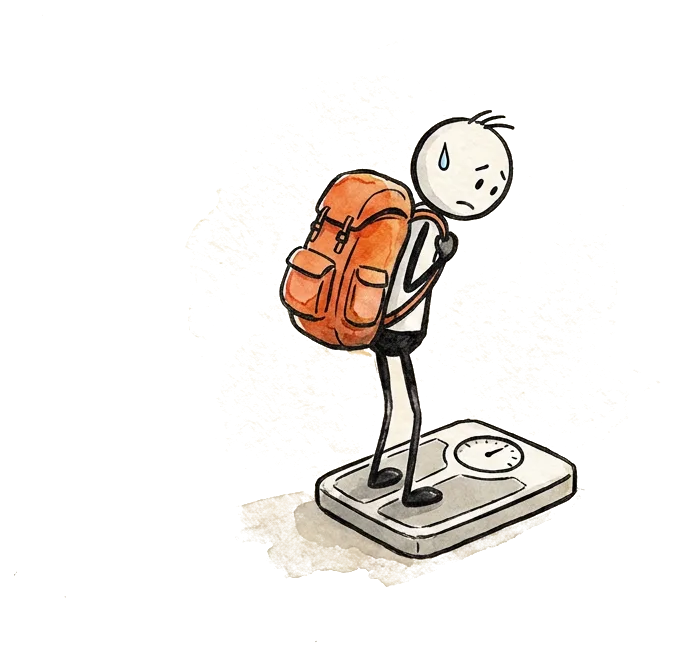
Ten percent.
You'll hear it before you've bought the backpack. From the forum, from your cousin, from the man in the outdoor store. Your pack should weigh no more than ten percent of you.
Nobody knows who said it first. The American pilgrims' association passes it on as accepted guidance, not a law. On the forums, one camp calls it the golden rule and the other camp calls it silly. And ask anyone who has walked, and you tend to get the same sheepish answer: they wish they'd taken it seriously sooner.
Here's what the rule can't do, and the one thing that can.
The rule, honestly
My bag is 22 pounds, and every single thing in it is necessary. Really necessary.
Every first bag is 22 and necessary. That's the whole problem with the rule: it gives you a number, and a number is easy to argue with. You decide water doesn't count, then that the boots on your feet don't count, then that the phone is basically part of your hand.
The other honest thing: the rule is a percentage of you, and some pilgrims point out that this makes no sense. Carrying more because you weigh more is backwards. Their version is simpler: keep the whole thing under about 20 pounds (10 kg), and lighter is better than under.
Both versions agree on one point. Nobody checks the number at the airport. Your shoulder weighs it, around eleven in the morning, on the third hill, and the shoulder does not round up.
The mailbox test
How would I even know what too heavy feels like? I've never carried a bag for six hours in my life.
You don't have to guess. Do the test. It costs one Saturday and no money.
Pack everything. Not the idea of everything, the actual everything: the boots on your feet, the poles, the full water bottle, the fleece you're "only bringing for the plane". Put the bag on the bathroom scale. Write the number down. Don't do anything about it yet.
Now put it on and walk out of your front door. Not to the car. Down the street, past the mailbox, around the block, and keep going for an hour. Real pace, real sidewalks, the same shoulders you'll take to Spain.
Somewhere around forty minutes the pack starts talking. A strap you didn't notice in the store. A heat between the shoulder blades. A small, clear list forming in your head of the things in that bag you would not miss.
Come home. Take out everything that was on the list. Don't negotiate with it, it was speaking for your shoulder. Weigh the bag again.
Next Saturday, do it again with the new bag. The second walk is quieter. The third one, some pilgrims say, is when the number stops mattering, because the bag has become the bag.
The neighbors are going to ask. They are. "Are you moving?" No. Farther than that.
The thing you forgot is for sale in Pamplona
Day three, a pharmacy on a square in Pamplona. A woman in a rain jacket is buying a toothbrush, a small tube of sunscreen and a packet of something for her heel. She left the first two at home on purpose, after the mailbox test told her the big bottles could go. The third one she didn't know she'd need.
This is the part the bag doesn't believe yet: the Camino Francés passes a pharmacy and a small supermarket most days, and an outdoor shop every few days, in the bigger towns. Most of what you'd pack "just in case" is waiting in the next town, in a smaller size. This isn't a wilderness. It's a country that has been patching up pilgrims for a thousand years, one small pharmacy at a time.
Plan B has a post office
Even after two Saturdays, some packs come out heavy. Some pilgrims are sixty-two and have decided, correctly, that they have nothing to prove to a hill.
The Spanish post office, Correos, runs a backpack service on the main routes. From early spring to the end of October (in 2026 it started in mid-March), you leave your bag at the reception of your hostel before 8 in the morning and it's waiting at the next place you've booked by about half past two. One bag, up to about 33 pounds (15 kg). Prices depend on the stretch; as an example, their site quotes Sarria to Santiago at 30 euros for the whole way. In winter it runs only on the last stretches into Santiago. (The rules for booking it the night before are in the day-three post.)
There's a second service most people don't know about. If you realize on day four that the fleece, the spare charger and the "nice" top for Santiago are never coming out of the bag, you can hand them in at any Correos office and they'll travel to Santiago without you, from about 21 euros. Fifteen days of storage are included, and you can buy more in advance if your walk is longer. You collect them at the main post office, a two-minute walk from the cathedral square, and carry a lighter bag for the rest of the way.
Isn't that cheating? The Compostela asks for at least the last 62 miles (100 km) on foot. It says nothing about what was on your back. The Camino counts your miles, not your straps.
The honest part
The test won't get every pack under the number. It may be a couple of pounds over on the day you fly, and that's fine. And the Correos service has limits: it needs a booked bed at the other end, it doesn't run everywhere in winter, and it's one more thing to organize the night before.
What the test does give you is the thing the rule can't. You'll know what your own shoulder thinks of your own bag before anyone in Spain does.
Before you go
- Weigh the pack twice: with the water bottle full, and without. The full one is the one you'll carry at nine in the morning.
- Do the mailbox test on two Saturdays, not one. The second walk is where the real list appears.
- The lightest things on the Shelf are the ones that replace something heavier. That's the only kind of shopping that makes a pack lighter.
- Write the Correos plan on the inside of your credencial cover: "bag at reception before 8 a.m., next bed booked". Then forget about it until the day you need it.
This was never a post about things. It's about what you're willing to carry for a month or more, and what you're willing to let a post office carry instead.
If you've walked: what came out of your pack on the mailbox walk, or on day three? And if you're still packing: what's the one thing in your bag you'd defend to the death?
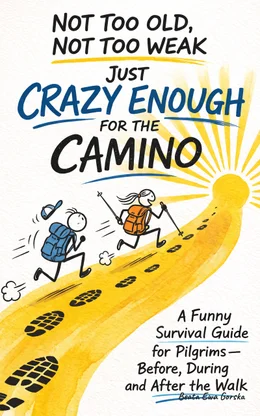 What actually goes in the pack, item by item, and the argument with yourself over a third fleece: that's Chapter 9 of the book. the book →
The Shelf: gear for the CaminoWhat buyers love, and what to know first. open the Shelf →
What actually goes in the pack, item by item, and the argument with yourself over a third fleece: that's Chapter 9 of the book. the book →
The Shelf: gear for the CaminoWhat buyers love, and what to know first. open the Shelf →